
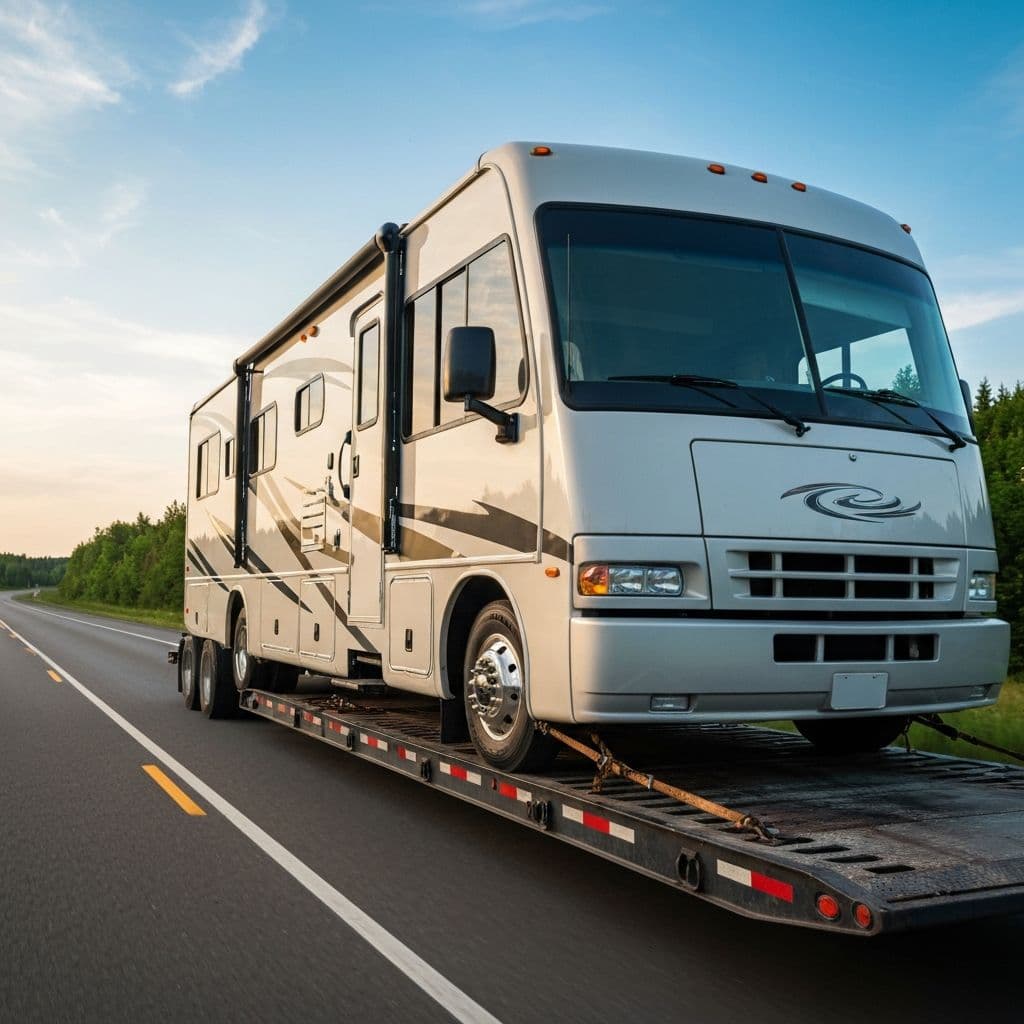
Motorhome shipping cost in Canada typically runs $1.60–$2.80/km, whether you're moving a Class A diesel pusher from Ontario to British Columbia, a Class C camper van between Alberta and Manitoba, or a Class B conversion van across the Maritimes. Red Foot Haulers runs lanes coast to coast — Ontario–Alberta, BC–Ontario, Quebec–Atlantic Canada, and every provincial hop in between — with transit times ranging from a day or two for short provincial moves to roughly a week or two for full cross-country transport, depending on routing, season and transport method.
How Much Does Motorhome Shipping Cost in Canada?
The honest, direct answer: budget $1.60–$2.80/km for motorhome shipping cost in Canada. That band isn't padding — it reflects real variables that change from one move to the next. A Class B van shipping drive-away on a short 300 km run within Ontario sits toward the bottom of that range. A non-running Class A diesel pusher requiring flatdeck transport across four provinces in January sits toward the top. Between those extremes, the price you land on depends on four things: the class of motorhome (A, B or C), whether it moves under its own power (drive-away) or rides on a flatdeck trailer, the total distance of the route, and the season you're shipping in.
This page focuses specifically on motorhomes — self-propelled Class A, B and C units. If you're shipping a travel trailer or fifth wheel instead, those are towable units with a different cost structure, and we cover that separately on our travel trailer and fifth wheel shipping page. For the full picture of how RV transport works across the country, including trailers, campers and motorhomes together, see our RV shipping Canada hub page.
It's also worth understanding what the $1.60–$2.80/km band is not. It is not a flat per-kilometer fee that applies identically to every unit regardless of size — a 40-foot Class A costs more per kilometer to move than a compact Class B van, even over the identical route, because it consumes more deck space (if flatdecked), requires more careful driving and permitting (if drive-away), and carries higher insured value. The band is a realistic planning range, not a single number, and the only way to land on an exact figure for your specific unit and route is to request a quote.
Rates by Transport Method
Motorhomes move by one of three methods, and the method chosen has a direct effect on where your cost lands inside the published band. Drive-away is generally the most economical option when the unit is roadworthy, insured for transport and within standard height limits. Flatdeck becomes necessary — not optional — when the motorhome doesn't run, has a mechanical issue that makes highway driving unsafe, or when insurance requirements for the specific move call for the unit to be carried rather than driven. Tow-away is rare for motorhomes since almost all Class A, B and C units are self-propelled rather than towed, but it occasionally applies to incomplete or chassis-only units being relocated.
| Transport Method | Typical Rate Band | When It Applies |
|---|---|---|
| Drive-away | $1.60–$2.80/km | Motorhome runs, is roadworthy, and meets height/insurance requirements for the route. Most common for Class A units in good mechanical condition and for Class B/C vans. |
| Flatdeck | $1.60–$2.80/km | Unit doesn't run, has a mechanical issue, exceeds a safe drive-away profile for the route, or insurance for the specific move requires the motorhome to be carried rather than driven. |
| Tow-away | $1.60–$2.80/km | Rare for motorhomes; applies mainly to chassis-only or incomplete units being relocated rather than to a finished, drivable Class A/B/C coach. |
Notice the rate band is the same across all three methods — the number that actually moves within that band is driven by the factors in the next section, not by the method label itself. Method mainly determines whether a move is even possible at a given price point, since a non-running unit simply cannot be drive-away regardless of budget.
What Moves the Price
Within the $1.60–$2.80/km band, several concrete factors push your specific quote up or down. None of these change the band itself, but each one shifts where your move lands inside it.
| Factor | Effect on Price |
|---|---|
| Class and length (A vs. B vs. C) | Longer, heavier Class A units push toward the upper end; compact Class B vans push toward the lower end. |
| Height (overpass clearance) | Taller units may require route planning around low overpasses, which can add distance or restrict carriers, pushing price upward. |
| Distance tier | Short provincial moves sit lower in the band; cross-country, multi-province moves trend toward the upper end due to routing complexity. |
| Season (winter Rockies/Prairies) | Winter transport through mountain passes or Prairie routes adds weather-related risk and delay, pushing price upward. |
| Whether it runs | A non-running unit requires flatdeck and specialized loading, which tends to push cost upward versus a roadworthy drive-away unit. |
| Escort or permit requirements | Oversize or over-height units needing pilot escorts or special permits push cost upward. |
| Pickup/delivery flexibility | Flexible dates and accessible addresses (no tight urban laneways, no narrow rural driveways) help keep price toward the lower end; rigid dates or difficult access push it upward. |
These factors compound. A tall, non-running Class A being flatdecked across the Rockies in February with a fixed delivery date will land at the top of the band. A short, running Class B van driving itself between two easily accessible addresses in the Fraser Valley in summer will land near the bottom.
Worked Examples Without Inventing Totals
Because motorhome shipping cost in Canada depends on the interaction of class, method, distance and season, we don't publish flat dollar totals for specific city pairs — a Toronto–Vancouver quote for a 32-foot Class A drive-away in July looks very different from the same route for a non-running Class A flatdeck in January, even though the distance is identical. Instead, here's how to estimate your own move.
Start with the driving distance in kilometers between your pickup and delivery addresses. Then pick a point inside the $1.60–$2.80/km band based on your specific circumstances: toward $2.60–$2.80/km for a short, roadworthy, flexible drive-away move in good weather; toward $1.90–$2.00/km for a mid-distance move with moderate complexity; and toward $1.60–$1.80/km for a long cross-country flatdeck move, a non-running unit, winter mountain or Prairie routing, or a large Class A with tight escort/permit requirements.
As a general pattern: a 4,000 km flatdeck move for a large, non-running Class A during winter sits toward the upper end of the band. A short provincial drive-away move for a running Class B or C van in summer sits toward the lower end. A mid-length move — say a few hundred to a couple thousand kilometers, running unit, drive-away, shoulder season — typically lands somewhere in the middle. These are planning ranges, not quotes; the only way to get an exact number for your unit and route is to submit your details through our quote form, where we account for your motorhome's real dimensions, running condition, exact addresses and preferred dates.
Class A, B and C — What Changes
The three motorhome classes behave differently for shipping purposes, mainly because of height, weight and how commonly they're roadworthy at the time of the move.
Class A motorhomes are the largest and heaviest, often 26 to 45 feet long, built on a bus-style chassis. They're frequently shipped drive-away when roadworthy, since driving them under their own power avoids tying up a flatdeck trailer for a unit that size. However, height (often 12 to 13.5 feet) can restrict routing around low overpasses, and mechanical issues on an older diesel pusher more often push these units to flatdeck than is typical for smaller classes. Weight and length can also trigger permit or escort requirements on certain routes.
Class B motorhomes are compact camper vans, typically under 7 feet tall and built on a standard van chassis (think Mercedes Sprinter or Ram ProMaster platforms). These are the easiest motorhomes to ship — low height means no overpass concerns, light weight keeps drive-away straightforward, and they rarely need special permitting. Class B units most often ship drive-away and tend to land toward the lower end of the rate band for a given distance.
Class C motorhomes sit between the two, built on a cutaway van or truck chassis with the distinctive over-cab sleeping area, typically 20 to 33 feet long. Height is moderate (usually under 11 feet), so overpass restrictions are less of a concern than with Class A units, and most Class C motorhomes ship drive-away when running well. Older units or those with mechanical trouble may need flatdeck, similar to Class A.
If you're shipping a towable unit rather than a self-propelled motorhome — a travel trailer, fifth wheel, or tent trailer — cost drivers like hitch weight, axle count and tow vehicle logistics come into play instead, and we've covered those specifically on our travel trailer and fifth wheel shipping page rather than here.
How to Get an Accurate Quote
To give you a precise motorhome shipping cost rather than a general band, we need a handful of specifics. Have this ready when you request a quote:
| Information Needed | Why We Need It |
|---|---|
| Year, make and model | Establishes weight, dimensions and typical mechanical profile for the unit. |
| Length and height | Determines whether special permits, escorts or overpass routing apply. |
| Both addresses (pickup and delivery) | Establishes exact route distance and flags any access constraints (narrow driveways, urban laneways, rural gravel roads). |
| Whether it runs | Determines whether drive-away is possible or flatdeck is required. |
| Preferred pickup/delivery dates | Affects scheduling, seasonal routing, and how much flexibility we have to optimize your price. |
Once we have these details, we confirm a firm quote in writing before anything is booked — no rate changes after the fact. Booking typically involves a deposit to secure your carrier and pickup window, with the balance due on delivery once you've inspected the unit and confirmed it arrived as expected. We'll walk you through the exact deposit amount and payment cadence for your specific move when we send your quote, so there are no surprises between booking and delivery.
For a broader look at how RV transport pricing and process works across the country — including trailers and campers alongside motorhomes — visit our RV shipping Canada hub. And if you're comparing carriers before booking, our RV hauling rates Canada page breaks down how different transport providers structure their pricing nationally.
Frequently Asked Questions
How much does it cost to ship a motorhome in Canada?
Generally $1.60–$2.80/km, depending on class, drive-away vs flatdeck, distance and season. Cross-country moves sit at the higher end of the band; short provincial hops at the lower end.
Is drive-away cheaper than flatdeck for a motorhome?
Usually yes when the motorhome is road-worthy and within height limits, because it does not consume a specialized trailer deck. Flatdeck is the right choice when condition, clearance or insurance requires the unit to be carried.
How long does cross-country motorhome transport take?
Often roughly a week to two weeks coast to coast, depending on season, routing and whether the move is drive-away or flatdeck. Winter weather on mountain and prairie segments widens the window.
Can Red Foot Haulers ship my RV to or from the United States?
No — Red Foot Haulers ships within Canada only. Importing an RV from the US involves CBSA clearance, RIV registration where applicable, and federal inspection — all outside domestic transport.