
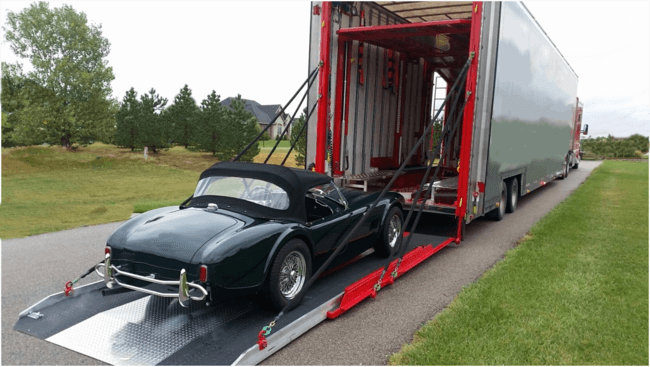
Enclosed car shipping moves your vehicle inside a fully covered trailer, protected from weather, road spray and public view, on lanes that run coast to coast across Canada — Vancouver to Toronto, Calgary to Halifax, Montreal to Edmonton and dozens of routes in between. Transit times run from a couple of days on regional moves to roughly a week or more on true coast-to-coast hauls, depending on distance, carrier scheduling and season.
Enclosed is $2.80–$3.30/km, $1.60–$2.30/km, and $1.10–$1.20/km on the same tiers. Open car shipping is $1.20–$1.40/km for 500–1,500 km, $0.80–$0.90/km for 1,500–3,000 km, and $0.60–$0.70/km for 3,000 km and over. Short hauls under 500 km are quoted.
Enclosed Car Shipping in Canada
With enclosed transport, your vehicle rides inside a soft-sided or hard-sided trailer rather than on an open rack — fully shielded from rain, snow, road salt, gravel chips and public view for the entire trip. It's a door-to-door service wherever access allows, and the standard choice for classics, exotics, freshly restored cars and any vehicle whose owner wants zero exposure. Enclosed is one tier within the broader car shipping Canada network Red Foot Haulers operates — the same carrier relationships and dispatch process, just a different trailer type and a smaller pool of equipment.
Soft-Sided vs Hard-Sided Enclosed Trailers
Not all enclosed trailers are built the same way. Soft-sided trailers use a rigid frame wrapped in heavy-duty fabric siding; hard-sided trailers are fully rigid, usually aluminum or steel-panelled, and typically found on the highest-end fleets. Both keep weather and debris off the vehicle — the real trade-offs are in security, capacity and availability.
| Factor | Soft-Sided Enclosed | Hard-Sided Enclosed |
|---|---|---|
| Weather protection | Strong — blocks rain, snow, UV and road spray | Strongest — fully rigid shell, no fabric flex in high wind |
| Security | Good; fabric sides deter casual view but can be cut in theory | Best; rigid walls and locked bays, preferred for six- and seven-figure vehicles |
| Capacity per trailer | Usually 2–7 vehicles depending on configuration | Often lower per trailer, sometimes single or dual-car set-ups |
| Availability across Canada | More common; easier to book on most enclosed lanes | Scarce; fewer operators, longer lead times, often booked out further |
| Typical use case | Most enclosed domestic moves — classics, exotics, restorations | Ultra-low-clearance supercars, concours vehicles, highest-value shipments |
For most enclosed bookings within Canada, soft-sided equipment does the job completely — it's what most carriers run, it's more available on short notice, and it delivers the same core protection from weather and debris. Hard-sided trailers make sense when the vehicle's value, ground clearance or owner's risk tolerance genuinely calls for the extra rigidity, but expect to book further ahead and accept a narrower list of carriers.
Which Vehicles Need Enclosed Transport
Enclosed isn't the right call for every car, and we won't upsell it when open transport suits the vehicle fine. The vehicles that genuinely benefit tend to fall into a few clear categories:
- Classic and vintage cars — original paint, chrome and interiors that road salt, UV or debris can permanently damage.
- Exotics and supercars — high replacement value plus, often, very low ground clearance.
- Low-clearance sports cars — aftermarket lowering springs, splitters or lips that standard open-carrier ramps can damage.
- Show cars and concours entrants — vehicles transported in competition-ready condition where even minor road film is unacceptable.
- Freshly painted or restored vehicles — paint that hasn't fully cured, or a restoration where the owner wants zero exposure until delivery.
- High-MSRP daily drivers — owners of newer luxury vehicles who prefer no chip, spray or debris exposure at all.
For a standard commuter car, an SUV headed to a new job posting, or a used vehicle bought online, open transport is almost always the sensible choice — more widely available and on more frequent lanes. Enclosed makes sense when the downside of exposure clearly outweighs the tighter scheduling that comes with it.
What Your Quote Depends On
The published per-km band above is a range, not a single number, because enclosed quotes are built from several independent variables. Here's what moves a quote up or down, and in which direction:
| Cost Driver | Effect on Price |
|---|---|
| Distance / distance tier | Longer hauls cost more in total but typically less per kilometre; short regional moves carry a higher effective rate per km because fixed costs spread over less distance. |
| Transport type: open vs enclosed | Enclosed costs more than open for the same lane — fewer vehicles fit per trailer and enclosed capacity is thinner. |
| Vehicle size and weight | Larger, heavier vehicles take up more deck space and reduce how many others fit on the load, pushing price up versus a compact car. |
| Ground clearance | Very low vehicles need careful loading, ramps or a winch, and may limit which trailers can carry them. |
| Whether it runs, rolls and steers | A non-running vehicle needs winching and extra handling time, raising the price versus one that drives on and off. |
| Season | Winter and peak snowbird periods push demand up on certain corridors, tightening capacity; shoulder seasons are typically more favourable. |
| Pickup-window flexibility | A flexible window lets dispatch slot your vehicle onto a truck already running the lane; a rigid single-day requirement can mean a dedicated or partially empty run. |
| Distance from a main highway | Remote or rural addresses off the primary corridors add deadhead mileage, reflected in the price. |
| How regularly carriers run the lane | High-frequency lanes (e.g., Vancouver–Calgary, Toronto–Montreal) are more competitively priced than thin or one-off routes. |
For enclosed shipments, the two factors that usually dominate are the open-vs-enclosed premium itself and how established the lane is — enclosed capacity is thin enough that booking a route carriers already run regularly makes a bigger difference than it does on the open side.
Availability and Booking Lead Time
Enclosed capacity across Canada is meaningfully thinner than open capacity, and on some lanes only a handful of operators run enclosed equipment at all. Booking further ahead matters more than on open transport, and flexible pickup dates make a bigger difference here — a two-to-three-day window rather than a single fixed date gives dispatch a much easier time slotting your vehicle onto a truck already scheduled to run your corridor. For popular corridors such as those covered on our western enclosed shipping page, lead times are generally shorter because more carriers run that equipment there.
Preparing a Vehicle for Enclosed Pickup
Preparation follows the same core checklist as any car shipment, with a few enclosed-specific additions:
- Wash the vehicle beforehand so the pickup inspection can clearly document existing chips, scratches and panel condition.
- Remove all personal belongings and aftermarket electronics; carrier cargo insurance usually does not cover items left inside.
- Leave roughly a quarter tank of fuel — enough for loading and unloading, without adding unnecessary weight.
- Disable or note any active alarm systems so they don't trigger during transit.
- Photograph the vehicle from all angles, including close-ups of existing wear, before the driver arrives.
- Note any fluid leaks and mention them to dispatch — this affects positioning relative to other vehicles.
- Confirm tire pressure and battery charge, particularly for classics that haven't been driven recently.
Ground clearance is a bigger factor than most owners expect — even a vehicle that runs, rolls and steers fine may need a winch-assisted load if the ramp angle is too steep for a low splitter or lip kit. Flag aftermarket spoilers, splitters and side skirts to dispatch ahead of time so the driver can plan the loading angle and strapping points; these are the parts most likely to be damaged by rushed loading.
Other Popular Routes
If your move is regional rather than national, our western Canada enclosed shipping page covers the Vancouver–Edmonton–Calgary corridor in more depth. Shipping a vehicle that doesn't start or won't roll is a distinct service — see our non-running car shipping page. And if you're shipping to or from a specific major city, our car shipping Vancouver and car shipping Calgary pages cover local pickup and delivery details directly.
Frequently Asked Questions
When should I choose enclosed car shipping instead of open?
Choose enclosed when weather exposure, road debris or theft risk matter more than cost — typically classics, exotics, low-clearance sports cars, show cars and high-value vehicles. For ordinary daily drivers, open transport is usually appropriate.
Is enclosed car shipping available door-to-door across Canada?
Yes, wherever the trailer can legally and safely access. Enclosed trailers are often larger or less manoeuvrable than open multi-car carriers, so a nearby arterial meet is sometimes needed in dense neighbourhoods.
What is the cheapest way to ship a car within Canada?
Open transport on a multi-vehicle carrier, booked with a flexible pickup window, on a lane carriers already run regularly. Enclosed trailers carry fewer vehicles per load; a rigid pickup date can force an empty slot; an established lane means the truck is already going. Terminal-to-terminal helps only when a terminal is genuinely convenient.
Is my car insured while it is being transported?
Yes. Every vehicle moves under the carrier's cargo insurance for the whole trip. Ask for the certificate and check the per-vehicle limit against what your car is actually worth — especially for enclosed loads. Your own policy generally covers the vehicle as an owned asset, not the carrier's handling of it.
Can Red Foot Haulers ship my car to or from the United States?
No — Red Foot Haulers ships within Canada only. Bringing a vehicle in from the US involves customs clearance, Registrar of Imported Vehicles (RIV) registration and a federal inspection, all outside domestic transport. Contact the CBSA or RIV for that process.