
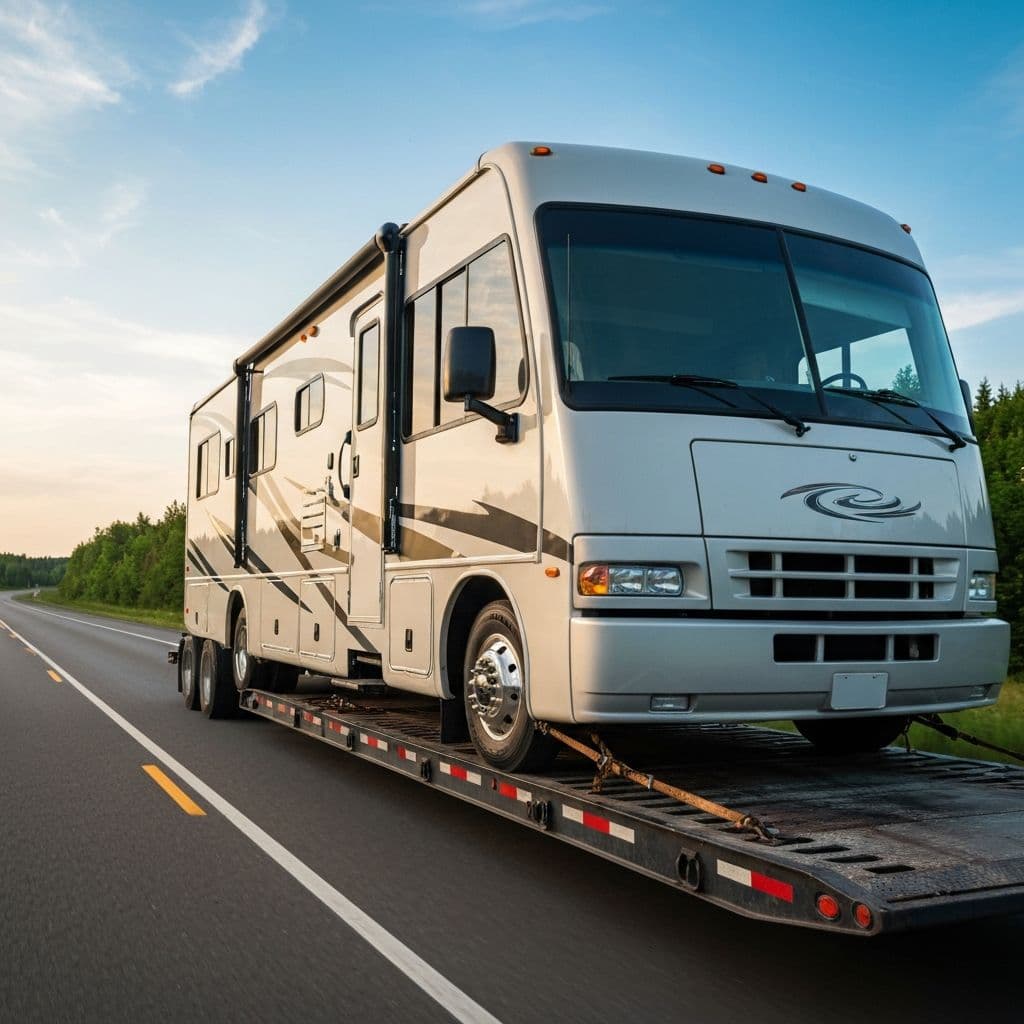
Canada's RV hauling companies move fifth-wheels, travel trailers, and motorhomes across every province, with the busiest lanes running between Ontario and Alberta, British Columbia and Ontario, and the Maritimes into central Canada. Typical transit runs 3 to 4 days on cross-country corridors and 1 to 2 days on regional moves. This page explains how to vet RV hauling companies Canada-wide before you hand over a deposit.
How to Choose an RV Hauling Company in Canada
A reliable RV hauler owns or directly contracts its trucks, carries cargo insurance with a stated per-unit limit, and gives you one accountable point of contact from quote to delivery. A load-board middleman, by contrast, collects your booking fee and then re-posts your unit to the cheapest available carrier, often with no say in who actually shows up. Neither model is illegal, but they carry very different risk profiles — and the difference rarely shows up on the homepage. For a breakdown of transport methods, rate bands, and how pricing actually works across RV shipping Canada-wide, that hub page covers the national picture; this page is specifically about telling a genuine hauler apart from a broker wearing a hauler's branding.
Start by confirming three things before you compare a single quote: does the company run its own trucks or arrange them, does it operate exclusively within Canada or also cross-border, and can it produce a certificate of insurance on request rather than just a promise in an email. Everything else — communication style, quote turnaround, review volume — matters less than those three facts.
Questions to Ask Before You Book
Work through this list with every company you're seriously considering. A confident, specific answer to each one is a good sign; vagueness on more than one is a reason to keep looking.
- Cargo insurance certificate and per-unit limit. Ask for the actual document, not a verbal assurance, and confirm the per-unit coverage limit is enough to cover your RV's replacement value.
- Who actually drives your unit. Is it an employee or contracted driver in the company's own network, or will your RV be auctioned off to whichever carrier bids lowest on a load board once you've paid?
- Canada-only or cross-border. If a company ships into the US, it's operating under a different regulatory framework — FMCSA authority, customs paperwork, RIV rules — than a Canada-only carrier. Make sure the scope matches your actual move.
- Written quote with inclusions. Does the number include pickup and delivery to your exact addresses, or does it assume terminal-to-terminal and add fees for residential access, long driveways, or low-clearance routes?
- Transporter plates and permits. Legitimate haulers carry provincial transporter plates and, for oversized units, the correct wide-load permits for the provinces they're crossing.
- Condition report process. Ask exactly how pickup and delivery condition is documented — photos, written notes, both parties signing off — and get a copy before the truck leaves.
- Deposit terms. What's the deposit amount, is it refundable if you cancel, and is the balance due on delivery rather than before the truck ever picks up your RV?
Red Flags
Watch for these patterns — any one of them alone is a caution; two or more together should end the conversation:
- Demanding full payment before pickup. Legitimate haulers take a deposit and collect the balance on delivery, not the reverse.
- No insurance certificate on request. If a company hedges, delays, or can't produce one within a day, assume there isn't adequate coverage.
- Pressure to book same-day with no dimensions collected. Accurate pricing requires length, height, weight, and whether the unit is towable or self-propelled — a quote given without asking for these is a guess, not a quote.
- Quotes far below the market range with no explanation of method. A price well under every other quote you've received, with no detail on how it's achieved, often means a load-board re-post at a lower carrier rate than promised — or a truck that never actually shows up.
- No verifiable Canadian operating presence. No business address, no reviews tied to actual moves, no way to confirm the company has completed hauls in the provinces it claims to serve.
Direct Hauler vs Bidding Marketplace
Both models exist for good reasons, and the right choice depends on what you're optimizing for. A bidding marketplace posts your RV to a pool of independent carriers who compete for the job, which can surface available capacity quickly, especially on odd routes or last-minute timelines. The tradeoff is that you're often dealing with a different carrier than the company you booked through, and accountability can get murky if something goes wrong in transit. A direct hauler owns the relationship end to end: the company that quoted you is the company whose truck shows up, inspects your unit, and delivers it — one accountable party for the whole move.
| Factor | Bidding Marketplace | Direct Hauler |
|---|---|---|
| Who drives your RV | Unknown until a carrier accepts the load | Known at time of quote |
| Accountability if something goes wrong | Split between marketplace and carrier | Single point of contact throughout |
| Speed on unusual or remote routes | Often faster — wider carrier pool | Depends on the hauler's own network coverage |
| Price transparency | Can shift after initial quote as carriers bid | Fixed once dimensions and route are confirmed |
| Insurance clarity | Varies by which carrier ultimately takes the load | One certificate, one policy, confirmed up front |
Choose a marketplace if you have flexible timing, a hard-to-place unit, and are comfortable managing the coordination yourself. Choose a direct hauler if you want one company responsible for your RV from the moment it's hitched to the moment it's parked in your driveway, with no handoff to a stranger midway through the trip.
What Actually Moves Your RV Transport Price
The published per-km band above is a range, not a single number, because RV transport pricing depends on too many variables to compress into one number honestly. What we can do is show you exactly what drives the quote, so nothing about the final number is a surprise.
| Price Driver | How It Moves the Number |
|---|---|
| Distance | Longer hauls cost more in total but typically cost less per kilometre as fixed costs (fuel to origin, driver time) spread over more distance. |
| Distance tier | Short regional moves (under a few hundred km) carry a higher effective rate than long cross-country runs, since minimum trip costs apply regardless of length. |
| Transport type — open vs enclosed | Open transport (drive-away or flatbed towing) is the standard and more affordable method for most towable RVs; enclosed transport, used for smaller specialty units needing full weather and debris protection, costs more due to trailer availability and handling time. |
| Vehicle size and weight | Longer, taller, and heavier units may require specific truck configurations, wide-load permits, or route planning around bridges and clearances, all of which add cost. |
| Whether the unit runs | A motorhome that starts and drives under its own power is faster and cheaper to load than one that needs to be towed or winched, which requires extra equipment and time. |
| Seasonality | Spring and early summer are peak RV-moving season in Canada; booking in that window with tight dates costs more than shoulder-season or flexible-date moves. |
| Remote pickup or delivery | Locations well off major highway corridors add deadhead miles for the truck on both ends, which shows up as a surcharge or a longer quoted transit window. |
Once you know your unit's length, height, weight, whether it runs, and your ideal pickup and delivery window, any hauler you're comparing quotes from should be able to walk through each of these drivers with you specifically — not just hand you a single number with no explanation.
Why Owners Pick Red Foot Haulers
Red Foot Haulers has operated Canada-only since 2016, with no cross-border operations to complicate insurance or customs questions. We've built a base of more than 700 reviews averaging 4.9 out of 5, and we handle every move door-to-door rather than terminal-to-terminal. Our published rate structure and transport methods live on the RV shipping Canada hub, where you can see how open and enclosed pricing actually breaks down before you request a number specific to your unit. If you're ready to compare a real quote against the checklist above, request one and ask us the same questions you'd ask anyone else — we expect that.
Other popular routes and formats we cover include camper and fifth-wheel trailer shipping and a full breakdown of motorhome shipping costs, both worth a look if your unit falls into either category.
Frequently Asked Questions
What should I look for in an RV hauling company?
Cargo insurance with a stated per-unit limit, clarity on who is driving, a written quote, a condition report at pickup and delivery, and honest answers about Canada-only vs cross-border scope.
Are RV transport brokers the same as haulers?
Not always. Some companies operate trucks; others arrange carriers through load boards. Ask who is contractually responsible if something goes wrong — that answer matters more than the brand name on the website.
How far ahead should I book RV transport in Canada?
Two to four weeks is comfortable on established lanes; longer for oversized units, peak summer, or remote pickups. Flexible dates usually get better equipment matches.
Can Red Foot Haulers ship my RV to or from the United States?
No — Red Foot Haulers ships within Canada only. Importing an RV from the US involves CBSA clearance, RIV registration where applicable, and federal inspection — all outside domestic transport.