
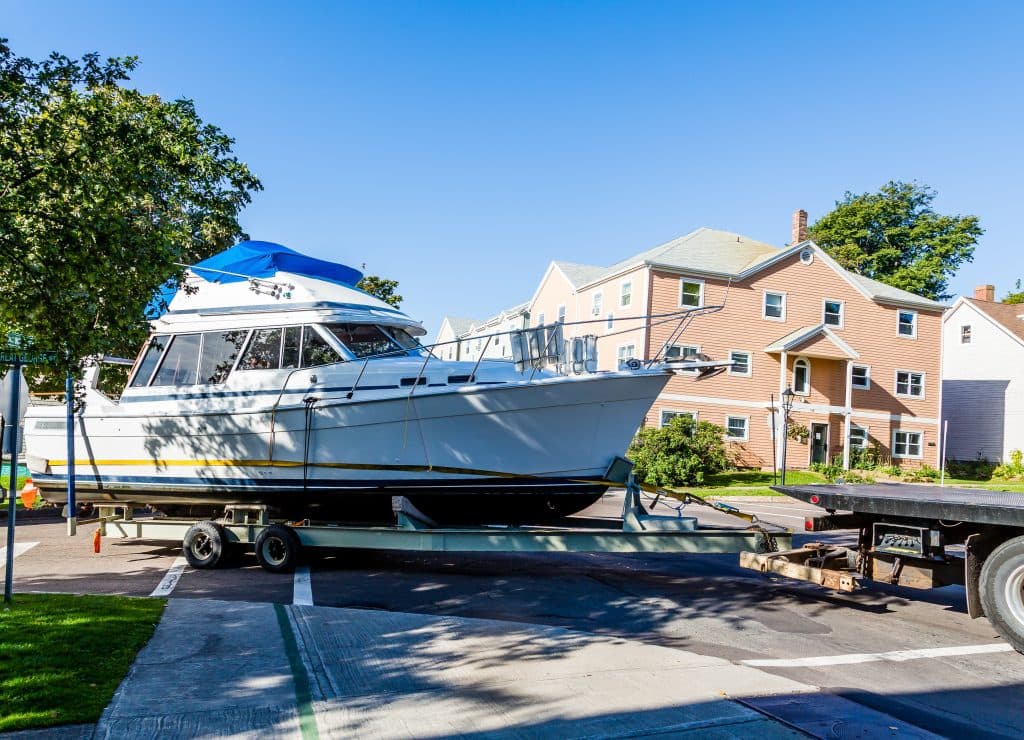
Red Foot Haulers moves boats and trailers together on lanes across the country every week — Ontario to Alberta, British Columbia to Manitoba, the Maritimes into Quebec — with tow-away transit typically running 3 to 6 days depending on distance and season. If you need to ship a boat and trailer anywhere in Canada, the trailer's condition decides both the method and the price.
Shipping a Boat and Trailer Together
Tow-away is the cheapest way to move a boat in Canada. Tow-away is $2.70–$3.10/km for 500–1,500 km, $1.70–$1.90/km for 1,500–3,000 km, and $1.30–$1.40/km for 3,000 km and over. Flatdeck is $2.60–$3.00/km under 3,000 km and $2.00–$2.10/km for 3,000 km and over. For very short distances (under 1,500 km), request a quote for a more accurate rate. The boat stays on its own trailer, a driver hooks up a commercial hitch, and nothing gets lifted, cradled, or strapped to a deck. The catch is that the method depends on one thing: the trailer underneath the boat has to be fit for highway driving — sometimes 3,000 to 4,000 km of it, not just the trip from your driveway to the boat launch. For the full breakdown of every shipping method, oversize permits, and the complete national rate structure, see our boat shipping hub.
Is Your Trailer Road-Worthy?
A trailer that's handled two years of trips to the local lake ramp isn't automatically ready for a cross-provincial highway run. Ramp trailers sit for months between short, slow trips; highway towing puts sustained loads on bearings, tires, and welds at 100 km/h for hours. Before we book a tow-away move, we walk through the same checklist our drivers use at pickup:
| Component | What we check | Why it matters |
|---|---|---|
| Tires | Trailer-rated (ST-load) tires, usable tread depth, correct inflation, no dry-rot or sidewall cracking | Idle trailer tires dry-rot faster than they wear — a blowout at speed can take the axle or fenders with it |
| Spare | A matching spare mounted and inflated, not just present in theory | A flat 400 km from the nearest tire shop with no spare stops the whole move |
| Bearings | Greased or repacked within a reasonable interval, hubs not running hot on a test tow | Bearing failure is the single most common trailer breakdown on long hauls |
| Lights | Brake lights, turn signals, running lights all functional and wired to a standard plug | Required by law, and critical after dark or in rain on unfamiliar highways |
| Coupler and chains | Coupler sized to fit a commercial tow vehicle's hitch, safety chains rated and intact | A coupler that doesn't match the hitch is an automatic no-go at pickup |
| Brakes | Trailer brakes (surge or electric) engaging properly if the trailer is equipped with them | Larger boat trailers are often required to have brakes; failed ones are a safety and legal issue |
| Frame and welds | No visible rust-through, cracked welds, or bent cross-members under the bunks | Frame failure under load is the scenario that damages the boat, not just the trailer |
| Registration | Current plate and registration where your province requires one | Unregistered trailers can hold up pickup or delivery at provincial checkpoints |
What We Check Before Loading
Our driver inspects both boat and trailer at pickup and again at delivery. We confirm the hull sits with continuous, even contact along the keel, and that structural support points — transom, keel, and factory-specified zones — bear the weight rather than gunwale or rail edges. The winch strap and bow eye get tested for wear and tension, and we check tongue weight and axle balance, since a boat too far back creates sway at speed while one too far forward overloads the tow vehicle's rear axle. Any failure at pickup pauses the load until it's corrected.
If Your Trailer Is Not Up to It
A failed inspection doesn't cancel your move — it changes the method, and usually the price. There are three ways forward:
- Repair first. If the issue is a bearing, a tire, or a light, we can hold the pickup date while a trailer shop handles it, then re-run the inspection before loading.
- We source a trailer. If your trailer is structurally unfit or the wrong size for the boat, we can source a suitable one. If you're buying rather than borrowing, boat trailers for sale is a good place to start.
- Move on flatdeck instead. If a trailer isn't available on short notice, the boat comes off the water, gets cradled, and travels on a flatdeck at a different rate.
How Your Boat Is Secured
Once the trailer passes, transom tie-downs get checked or added so the stern can't lift or shift under braking — bow-and-stern strapping alone isn't enough at highway speeds. Loose items get stowed, hatches and windows get closed and taped, tanks get drained where practical, and batteries get disconnected for a multi-day trip. If you want the boat covered, it needs to be a highway-rated transport cover or proper shrink-wrap — a mooring or storage cover shreds within the first few hundred kilometers under sustained wind loading at highway speed.
What Tow-Away Costs
Tow-away pricing is distance-based and depends on the trailer passing inspection. When it does, tow-away is $2.70–$3.10/km for 500–1,500 km, $1.70–$1.90/km for 1,500–3,000 km, and $1.30–$1.40/km for 3,000 km and over. When the trailer isn't usable and the boat moves on a flatdeck instead, flatdeck is $2.60–$3.00/km under 3,000 km and $2.00–$2.10/km past 3,000 km, since that method requires a cradle, tie-down points on a commercial deck, and often a crane or travel lift at both ends. For very short distances (under 1,500 km), request a quote for a more accurate rate. Oversize width or height is quoted per route, since permit requirements vary by province.
| Method | Rate | When it applies |
|---|---|---|
| Tow-away (boat and trailer) | $2.70–$3.10/km (500–1,500 km); $1.70–$1.90/km (1,500–3,000 km); $1.30–$1.40/km (3,000 km+) | Trailer passes the road-worthiness inspection at pickup |
| Flatdeck | $2.60–$3.00/km under 3,000 km; $2.00–$2.10/km past 3,000 km | Trailer is not usable, boat under 25 feet moves cradled on a deck |
| Oversize width/length | Quoted per route | Beam, height, or length exceeds standard highway limits and needs permits |
As a real-world example: a 24-foot cruiser moving tow-away from Ontario to Alberta — 3,442 km on the Toronto–Calgary lane — typically lands near $4,450–$4,800 all-in, assuming the trailer passes with no repairs needed. Shorter regional moves use the higher mid-haul band. For a full look at what moves that rate up or down — fuel, route, season, escort requirements — see the complete cost breakdown on our boat transport hub.
Preparing for Pickup
Getting ready means working through the trailer checklist and boat prep together, ahead of the driver's arrival. On the trailer: confirm tire pressure and tread, check the spare is mounted and inflated, test all lights through a standard 4- or 7-pin plug, and have current registration on hand. On the boat: drain tanks, disconnect the battery, remove or lash down anything loose, and either fit a highway-rated cover or leave the boat uncovered. Before you request a quote, take clear photos of the boat on its trailer from the front, back, and both sides, and have the loaded dimensions ready — length, width, and height with the boat on the trailer, since windshields, radar arches, and outboards often add to overall height. Loaded dimensions submitted with your quote also let us flag any oversize permit needs before pickup day.
Frequently Asked Questions
What makes a trailer road-worthy for tow-away shipping?
Trailer-rated tires with usable tread, a matching spare, greased bearings, working lights and brakes, a coupler that fits a commercial hitch, sound frame welds, and current registration where your province requires a plate. If any of those fail on pickup day, we pause and switch to repair, a sourced trailer, or flatdeck.
What if my trailer fails the inspection?
You can repair it first, we can source a suitable trailer and load the boat onto it, or we can move the boat on a flatdeck. None of those options cancels the move — they change the method and the quote.
How much does shipping a boat and trailer cost?
Tow-away boat shipping is $2.70–$3.10/km for 500–1,500 km, $1.70–$1.90/km for 1,500–3,000 km, and $1.30–$1.40/km for 3,000 km and over. Flatdeck is $2.60–$3.00/km under 3,000 km and $2.00–$2.10/km for 3,000 km and over. For very short distances (under 1,500 km), request a quote for a more accurate rate. Oversize width or length is quoted per route.
Do you ship sailboats on their own trailers?
Yes, when the trailer is purpose-built for the keel and the mast is unstepped before pickup. Keel depth and loaded height decide whether tow-away is still legal on your route; otherwise the boat travels in a cradle on a flatdeck.
How should I prepare the boat before pickup?
Drain tanks, disconnect batteries, stow or remove loose gear, close and tape hatches, and use a highway-rated cover or shrink-wrap if you cover the boat. Have loaded length, width and height ready with a photo when you request the quote.
Can Red Foot Haulers ship my boat to or from the United States?
No — Red Foot Haulers ships within Canada only. Importing a boat from the US involves CBSA clearance and other federal requirements outside domestic transport.
Other popular routes and resources: browse boat trailers for sale if you need a trailer sourced before pickup, or check where we ship Canada for a full list of lanes and regions we run regularly.