
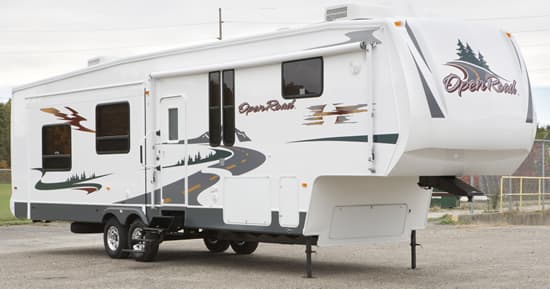
Travel trailer transport Canada services from Red Foot Haulers move bumper-pull trailers, fifth wheels, campers and toy haulers door-to-door between any two Canadian provinces. Common lanes include Ontario–Alberta, BC–Manitoba, and Atlantic Canada into Ontario, with typical transit times running 3 to 8 days depending on distance and route density. Rates generally fall between Tow-away RV shipping is $2.60–$2.80/km for 500–1,500 km, $1.90–$2.00/km for 1,500–3,000 km, and $1.60–$1.80/km for 3,000 km and over. Drive-away is $1.90–$2.30/km. Flatdeck is quoted per route..
Travel Trailer and 5th Wheel Transport Across Canada
Red Foot Haulers hauls travel trailers, fifth wheels, campers and toy haulers door-to-door anywhere within Canada. Whether you've bought a used trailer from a dealer in another province, sold your fifth wheel to a buyer three time zones away, or need a toy hauler moved to a new home base for the season, we quote the job based on the actual unit, not a generic flat rate. Pricing generally runs Tow-away RV shipping is $2.60–$2.80/km for 500–1,500 km, $1.90–$2.00/km for 1,500–3,000 km, and $1.60–$1.80/km for 3,000 km and over. Drive-away is $1.90–$2.30/km. Flatdeck is quoted per route. depending on the transport method, the size and weight of the unit, and the distance involved. For the broader picture of how this fits into national RV shipping Canada services — motorhomes, fifth wheels, and everything in between — that hub page breaks down the full vertical. This page focuses specifically on trailers, campers and towables.
We ship within Canada only. We do not cross-border haul into or out of the United States, and every quote, timeline and prep note on this page assumes a domestic Canadian pickup and delivery.
Tow-Away vs Flatdeck for Trailers
Every travel trailer or fifth wheel move happens one of two ways: tow-away, where a driver hooks directly to the trailer's own coupler or kingpin and tows it on its own wheels, or flatdeck (sometimes a lowboy), where the unit is loaded and secured onto a deck trailer for the trip. Which method applies depends on the condition of the unit and whether it's road-worthy.
| Method | How it works | Best for | Typical cost driver |
|---|---|---|---|
| Tow-away | Truck hooks to the trailer's coupler (bumper-pull) or kingpin (fifth wheel) and tows it door-to-door on its own tires | Road-worthy units with good tires, working brakes and sound coupler/hitch components | Generally the cheaper option; priced mainly by distance and size |
| Flatdeck / lowboy | Unit is winched or loaded onto a deck trailer and strapped down for the haul | Damaged axles or frames, unlicensed units, flat tires, non-functioning brakes, or trailers that simply shouldn't roll on public highways | Higher cost due to loading equipment, deck space and extra securement time |
If your trailer isn't currently plated, that's not a dealbreaker — professional carriers can typically supply a temporary transporter plate to move it legally between provinces. If in doubt about the reliability of a carrier offering either method, our guide to vetting RV hauling companies covers what to check before you book.
Travel Trailers
Bumper-pull travel trailers are the most common unit we tow-away, but they still need a pre-trip check before a driver hooks up. We look at the coupler for cracks or excessive play, confirm the safety chains are intact and rated for the trailer's weight, and test the electric brakes and breakaway switch. Tires get inspected for age as much as tread — a trailer that's sat for two years can have plenty of tread left on tires that are still five years old and due for a blowout. Tongue weight matters too: an improperly loaded trailer with too little weight on the tongue is prone to sway at highway speed, and our drivers will flag anything that feels unstable during the initial hookup and short test pull before committing to a long haul.
Before pickup, a quick trailer-specific prep checklist helps things go smoothly:
- Coupler and hitch ball match, with no visible cracking or corrosion
- Safety chains attached and in good condition
- Brake controller and breakaway cable functional
- Tires inflated to spec, and not older than 5–6 years regardless of tread depth
- Interior cargo secured or removed so nothing shifts en route
Fifth Wheels
Fifth wheels hitch differently than bumper-pulls — the kingpin drops into a receiver mounted in the bed of a heavy-duty tow truck, rather than a ball hitch on a standard receiver. Before towing, we check the pin box for wear, confirm the landing gear operates smoothly for hookup and setup, and verify the unit's overall towed height clears standard overpasses and bridges along the route, since fifth wheels sit noticeably taller than bumper-pull trailers once hitched. This height and weight profile is also why fifth wheels are almost always moved tow-away rather than flatdeck — loading a fifth wheel onto a deck adds height on top of height, which can push a load into oversize territory unnecessarily. Flatdeck is reserved for fifth wheels with structural damage, bent frames, or non-functional axles that make towing unsafe.
Larger fifth wheels — triple-axle units, or anything approaching or exceeding standard width and height thresholds — may trigger oversize load permits depending on the province and route. We handle permit requirements as part of the quote, but it's worth mentioning your unit's exact dimensions (width, height when hitched, and length) when requesting a rate so the permit cost, if any, is built in up front rather than surprising you later.
Campers, Pop-Ups and Toy Haulers
Not every towable unit moves the same way, and being upfront about what each type needs keeps quotes accurate:
- Truck campers sit in the bed of a pickup and typically move either still mounted on a compatible host truck, or on a flatdeck if there's no truck making the trip. Loose truck campers without a host vehicle almost always need flatdeck transport.
- Pop-up (tent) trailers are generally the simplest tow-away job — light, low, and road-worthy when folded down properly, assuming the frame, tires and coupler check out like any other bumper-pull.
- Toy haulers tow like a travel trailer or fifth wheel depending on configuration, but need the garage door/ramp secured and locked, and any cargo — ATVs, motorcycles, gear — removed or properly strapped down inside before pickup. An unsecured garage door or loose cargo shifting in transit is one of the most common (and preventable) causes of transport damage.
What Your Quote Depends On
Every quote for travel trailer, fifth wheel or camper transport comes down to a handful of concrete factors, not a flat per-unit price:
| Factor | Why it matters |
|---|---|
| Distance | The core driver of total cost — longer hauls cost more overall but generally a lower rate per kilometer |
| Tow-away vs flatdeck | Flatdeck adds loading equipment, time and deck space, generally raising the per-km rate |
| Length, height and width | Oversize dimensions can require permits and route planning around bridges, overpasses and weigh stations |
| Weight and axle count | Heavier, multi-axle units may require heavier-duty tow vehicles and affect routing |
| Season | Winter routes through mountain passes or northern provinces can affect scheduling and pricing |
| Road-worthiness | A unit with bad tires, non-functioning brakes or frame damage may need flatdeck instead of tow-away |
| Pickup/delivery flexibility | Flexible dates that fit around other loads on the same lane typically price better than rigid, single-day windows |
| Method | Typical rate band |
|---|---|
| Tow-away | Tow-away RV shipping is $2.60–$2.80/km for 500–1,500 km, $1.90–$2.00/km for 1,500–3,000 km, and $1.60–$1.80/km for 3,000 km and over. |
| Flatdeck / lowboy | Tow-away RV shipping is $2.60–$2.80/km for 500–1,500 km, $1.90–$2.00/km for 1,500–3,000 km, and $1.60–$1.80/km for 3,000 km and over. |
If you're moving a drivable motorhome rather than a towable trailer, cost drivers differ enough that we cover them separately on motorhome shipping costs.
Preparing Your Trailer for Pickup
A well-prepped trailer moves faster at pickup and arrives with fewer surprises. Before your driver arrives, work through this list:
- Empty fresh, grey and black water tanks completely — full tanks add weight and risk in transit
- Confirm propane tanks are shut off at the valve
- Retract and secure awnings; remove or tie down antennas and satellite domes
- Remove loose interior items — dishes, electronics, anything that can shift or fall in cupboards and drawers
- Lock all exterior doors, compartments and the garage door on toy haulers
- Check and adjust tire pressure to the trailer's rated spec
- Disconnect the battery if the unit will sit for an extended period before or after transport
- Take dated photos of the exterior from all four sides, plus any existing dents, scratches or damage
That last step matters more than it looks. The condition report — your photos plus the driver's inspection at pickup — is the document both sides rely on if a damage claim ever comes up. A trailer with clear "before" photos protects you; one without them leaves room for disagreement about what happened when.
Other popular routes worth reviewing if you're shipping a different kind of unit or comparing services: our camper trailer transport page covers similar ground for smaller units, and if you're shipping a car alongside your trailer or instead of it, see car shipping Canada.
Frequently Asked Questions
How much does it cost to transport a travel trailer in Canada?
RV and trailer transport generally ranges from Tow-away RV shipping is $2.60–$2.80/km for 500–1,500 km, $1.90–$2.00/km for 1,500–3,000 km, and $1.60–$1.80/km for 3,000 km and over. Drive-away is $1.90–$2.30/km. Flatdeck is quoted per route., depending on tow-away vs flatdeck, size, distance and season. Ask for a quote on your specific unit and route.
How do you transport a fifth wheel?
Usually tow-away: a heavy-duty truck hooks to the kingpin and tows it door-to-door. Flatdeck is used when the unit is damaged, not road-worthy, or otherwise should not be towed.
Do I need my trailer licensed and insured for transport?
Professional carriers can often supply a temporary transporter plate if the unit is unplated. Cargo moves under the carrier's insurance — ask for the certificate and per-unit limit.
Can you haul a toy hauler or truck camper?
Yes. Toy haulers need the garage door secured and cargo removed or strapped. Truck campers are usually moved on a flatdeck or with the host truck, depending on the setup.
Can Red Foot Haulers ship my RV to or from the United States?
No — Red Foot Haulers ships within Canada only. Importing an RV from the US involves CBSA clearance, RIV registration where applicable, and federal inspection — all outside domestic transport.